The armature (the kathamo)
The foundation of the image is a wooden platform known as the kathamo (from kath meaning wood). The kathamo is made of intersecting planks of wood which are nailed or bolted together. The wood in traditional images was mango wood but now any kind of hardy wood is used. Holes are drilled at appropriate places and vertical bamboo rods are inserted in them. These hold the figures in place. In single standing figures, the entire framework is reinforced with large wooden poles angles strategically to hold the weight of the figure. The figures may be made on the kathamo base or raised on a dais known as a simhasan or vedi. The simhasan is built over the kathamo using spliced bamboo arranged in strips and tied together.
The backdrop (the chali) and base (simhasan)
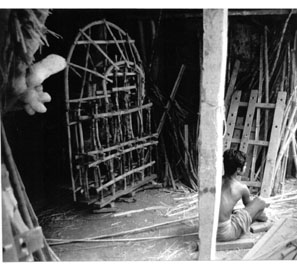
A common feature of the hand-modelled terracruda images is a semi-circular backdrop known as the chali (from cala meaning shelf or roof, the thatched roof of a house for example). In complex images having more than one figure, the chali acts as a unifying framework, enclosing the figures and supporting them. Additional figures surrounding the central figure are suspended from bamboo struts tied firmly to the chali. In this case the figures are supported by the chali rather than the kathamo below. Single figures do not usually have a chali and are fixed directly onto the kathamo. Chalis are made in different shapes and sizes and range from simple semi-circle or rectangle to more complex designs. They may be detachable in the case of larger images which need to be manoeuvred in and out of buildings. The chali is often made in segments and assembled once the image has been installed in the place of worship. The chali is sometimes covered with cloth stretched tightly over the packed surface and tied at the back. This kind of chali is known as markina chali (markina being a coarse kind of cloth). Attention is given to the front of the image whereas the back is usually left rough.
Whereas the kathamo is made of wood the chali and simhasan are made of strips of bamboo tied firmly together. Bamboo is popular because it is pliable and light when cut into strips yet is capable of offering firm support. This bamboo is cut into varying degrees of thickness and tied firmly with string to form the bulk of the armature. There is a dying practice of using a hardy red wood from the Sundarbans region of southern Bengal called goran (mangrove). Although mangrove was once cheap and popular, with escalating prices it has been replaced by bamboo. In some cases, however, the chali and simhasan are made of plywood or matting. Once the chali and simhasan are formed, they are packed with a rough mixture of clay and straw. This is later covered with a layer of finer clay to produce a smooth finish to the overall structure.
The chali and simhasan are also painted and given elaborate floral and geometric designs. They are usually painted light blue, perhaps to symbolise sky or water as in the images of Lakshmi and Saraswati who both have sloping simhasans painted with wavy lines in dark blue to symbolise water. Even the kathamo on single images is given a coat of blue paint. The chalis on larger images are often decorated with a painted frieze known as the chalcitra depicting mythological scenes connected with the deity. The chalcitra was once painted directly onto the top part of the chali but is now painted on a bit of primed newspaper and stuck on using glue.
The straw figures

The straw figures are made and attached to the simhasana, kathamo and chali where one is required. Ulu grass and paddy straw were used for the construction of the straw figures in the 19th c. Today, they are made by tying bundles of straw firmly together with string. The straw cores provide the basic shape and most of the volume of the figures and it is at this stage that the artist has to decide the overall composition of the image. The straw figures may be made around the protruding bamboo rods inserted in the kathamo or the struts in the chali or they be made separately and attached later. There are no skeletal pieces of bamboo or wood inside the straw figures other than the rods and struts used to attaché them to the framework. Small, sharpened bamboo pegs are used to secure one straw figure to another. The angling of the limbs is done by tying the straw tightly with string. They remain in their postures despite successive layers of clay due to the tight packing of the straw. Straw figures are made without extremities such as head, fingers or toes.
Stage 2 - Making the clay images and the painting process