
The clay (mati)
There are four kinds of clay used in making terracruda images in Bengal. The first is loamy clay called entel mati. The second is sandy clay called balu mati. The third is mixed clay called doams mati. The fourth is clay mixed with husks called tus mati.
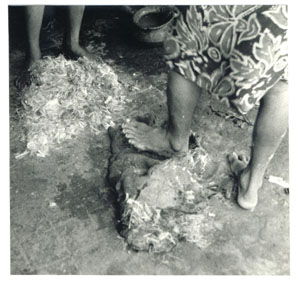 Most centres of clay image making are close to rivers. Kumartuli and Kalighat in Calcutta are only yards from the Hooghly river although Kumartuli imports clay from Uluberia in the Midnapore district. The most famous centre of clay art in West Bengal, Krishnanagar in the Nadia district, is situated on the banks of the Jalangi river which yields a reddish clay. As in the classical tradition of image making, the clay is tempered and mixed with various basic ingredients before application.
The clay is applied in two layers, the process being known as domati (do, two, mati, (layers of) clay). The first is riverine, adhesive clay known as entel mati, a sticky clay that is applied roughly be hand over the straw cores once they have been attached firmly to the framework.
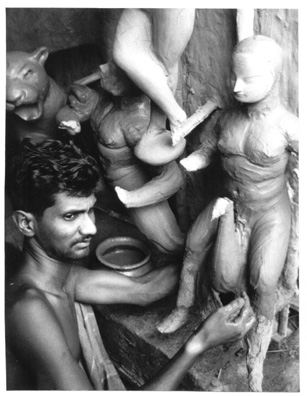
After the first layer of clay has been allowed to dry, the second layer, called balu mati, because it is sandy (balu) clay, is watered down and filtered through a cloth and then applied to produce a smooth finish. Cowdung was used in the 19th c, probably being mixed with the balu mati to soften it. Whereas the first layer of clay is dark, the second layer is usually lighter in colour. Anatomical details such as beauty lines around the neck and navel are executed with a bamboo stick that is pointed at one end. The clay surface may be smoothed with water and an ordinary paintbrush or a piece of cloth dipped in clayey water.
Having added the second layer of clay, it is allowed to dry thoroughly in the studio or out in the sunshine for a few days. Various means are used to accelerate the drying process such as pinning hot charcoal onto the image and baking mould pieces lightly over an open fire, but these are only emergency methods when there is little sunshine or excessive rain.
Additional items such as head, fingers and toes, are made from moulds or by hand. The clay used in moulds is doams mati (do, two, ams, parts) which is a mixture of entel mati and balu mati. Doams mati is adhesive enough to form the impression, yet not so sticky that it cannot be removed from the mould. For the production of the head, the face mould is first dusted inside with ash. Doams mati is pressed firmly into the face mould and then another kind of clay, tus mati, a kneaded mixture of entel mati and husks of jute or fibre, is modelled to form the back of the head. The head is then removed from the mould and allowed to dry in the sun.
Face moulds
The head made from a mould is hollow and open at the top and the neck. Face moulds include all the facial details and end at the top of the forehead.
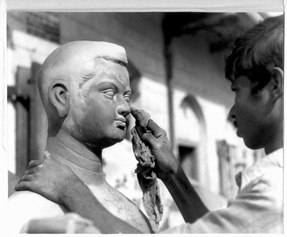 The opening at the top of the head is modelled over later when the head has dried and been positioned on the neck of the figure. The neck is either a protruding neck of straw or a bamboo peg inserted at the top of the straw core. The head is often bandaged onto the neck with thin muslin cloth to give the back of the head a smoother finish and to ensure it stays on the neck.
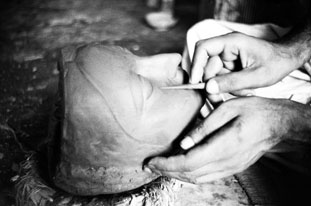 Before the head is allowed to dry, the features are refined using a bamboo splint and a wet paintbrush. The face is an important part of the image and great care is taken over the features. The head may be modelled by hand in which case lumps of moist entel mati are added gradually over the neck. In certain cases, the head has to be hand-modelled, as with the figure of the elephant-headed god Ganesh. In this case a straw core is designed to provide the bulk of the head and give sufficient support for Ganesh's elephant trunk. The head is made in the same way as the rest of the body using two layers of clay. The same applies for large animal figures, such as the lion in the Durga image, but where the animals are small, moulds are used. Most terracruda images have moulded heads.
Painting
When the image has been allowed to dry completely and any cracks have been smoothed over with balu mati, the painting process may begin. The back of the image is left rough and unpainted since it is not visible during worship. A chalk-based white paint is applied over the entire framework using a damp cloth or paintbrush. This ensures that the colours of the paint remain bright and are not darkened by the colour of the clay underneath. Once the white slip has dried, the paint is applied in one layer. The paint used today is ordinary powder-based watercolour, although it is mixed with the gum of boiled tamarind seed to give it greater viscosity.
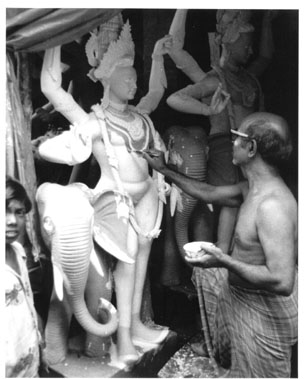
The traditional mineral and vegetable pigments used in the 19th c probably took a long time to make, whereas modern paints are mixed and ready for use in a short time. Mineral pigments once used included yellow harital (sulphate of arsenic ground and mixed with gum of bel fruit, hingul a coarse sulphate of mercury and jangal, verdigris with varnish of garjan oil. Indigo (nil) and ground conch-shell (sankh) were used to produce blue and white respectively. The paint used today is applied with an ordinary paintbrush. There is no sequence to the painting process. Sometimes the eyes and the facial details are painted first or else the body is painted first and the eyes are left till last.
The colours used on images are bright primary colours, although the modern trend is towards blended colours and shading. Recently it has become popular to colour images entirely in metallic colours, in which case the images are first given a red base instead of a white base before painting. Ornaments and decorations are usually painted silver or gold or sprinkled with silver or gold dust.
After the paint has dried, a glossy sheen is given to the image using boiled arrowroot or varnish. This protects the surface of the image and heightens the colour and gives a shiny effect on the images when they are illuminated at night by lamps placed around them. It also has aesthetic significance. Mild perspiration is regarded as a mark of beauty. The varnish is called gham tel (gham meaning perspiration). However, not all images have this glossy sheen and it depends on the artist's discretion or the customer's demands. Realistic, modern images tend to have a finishing layer of varnish.
Stage 3 - Decorating the images